Welcome to the age of technology. Since entering this era, technology has become more readily accessible to both teachers and students. Teachers now have the opportunity to allow students to discover science on a first-hand basis rather than relying on the experiences of others. With the advantage of technological software and hardware, learning becomes more meaningful, appeals to different types of learners, and reinforces the concepts being taught.
We took advantage of such technology by including it in the experiment we carried out to introduce the concept of physical changes of matter and how temperature affects the states of matter. We decided to begin with the most familiar substance: water.

To display these changes, we began with a pot of frozen water. Using the digital temperature probe and its corresponding software program Logger Pro, we simply connected its USB cord into the computer and placed the probe into the pot of ice in order to calculate and record the current temperature of the ice.

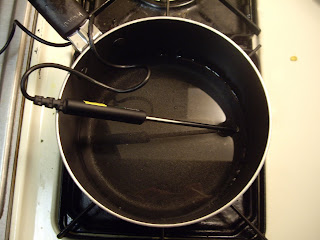
Leaving the probe in the pot of ice, we then increased the temperature of the burner. As the probe recorded the increase in temperature by graphing it on the computer, we observed how the water transformed from a solid to a liquid state.
Increasing the temperature of the burner yet again, we left the probe in the pot to continue recording the changes in temperature of the water until it transformed into its final state, a gas.
We concluded the experiment by observing the graph on the computer and analyzing the correlation between the increase in temperature and each physical state of water.
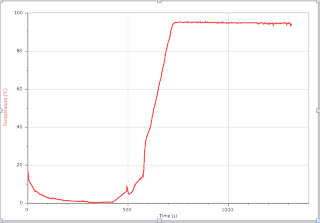
Although basic experiments, like the one we accomplished, can be performed in the classroom in old school fashion, technology like the portable, digital probe provides more accurate data, graphs changes in temperature in real time and exposes students to the limitless possibilities technology has to offer. Furthermore, with the supplement of this particular technology, students are learning how to observe a set of data as well as analyze, identify, and describe the relationships involved with temperature and physical states of matter as shown on graphs.